
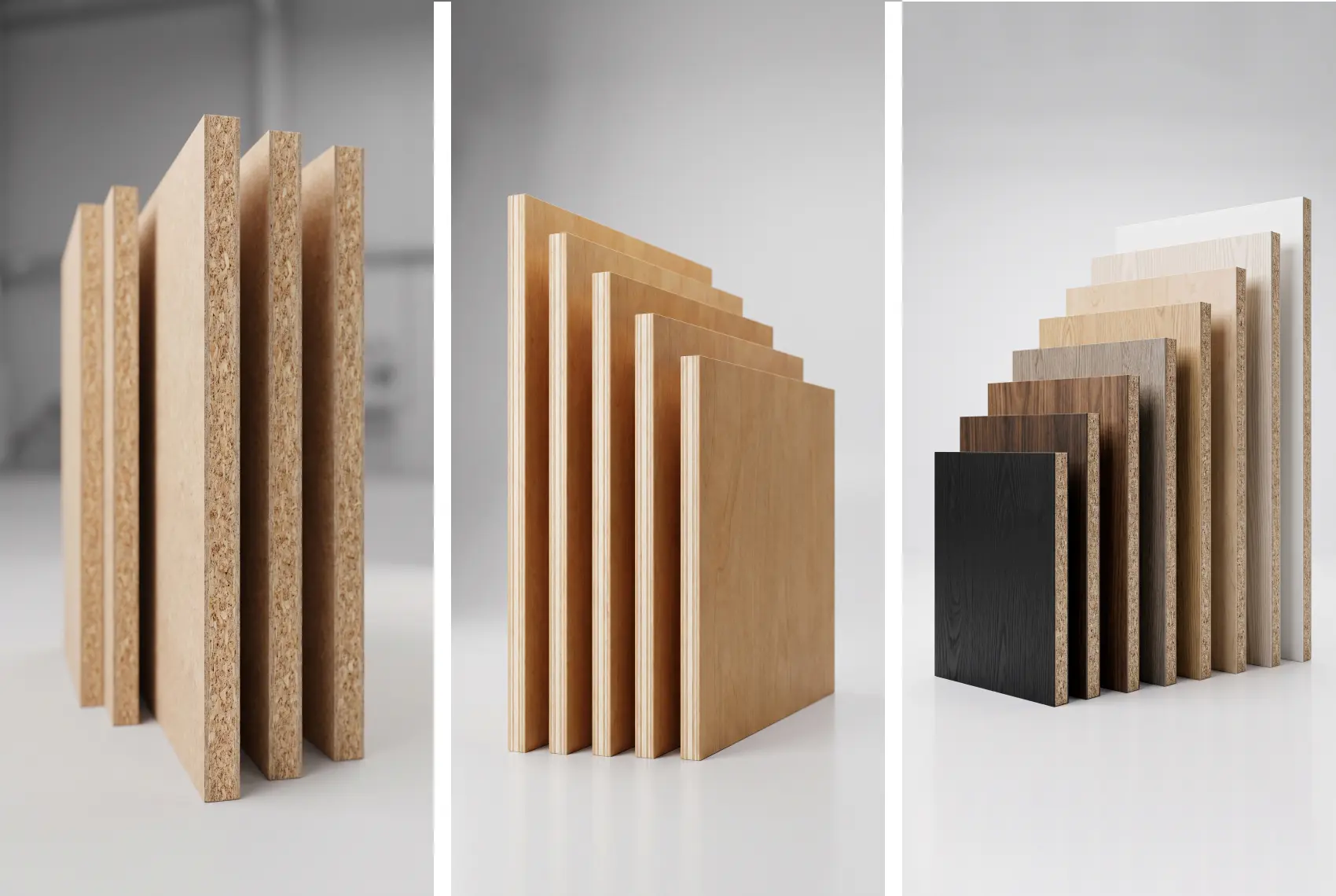
MDF offers a smooth, consistent surface that suits painted and routed components. Plywood provides excellent structural strength and dependable screw holding, although it generally costs more. Melamine-faced board arrives with a durable decorative surface already applied, making it a practical option for carcasses, shelves and flat-pack cabinetry.
This guide compares MDF vs plywood vs melamine cabinets from a cut-to-size and cabinet-making perspective. It is designed for Melbourne builders, cabinetmakers, carpenters, renovators and experienced DIY customers who need accurately machined components that are ready for efficient assembly.
Quick answer: which board should you choose?
For many cabinetry projects:
- Choose MDF for painted doors, routed profiles and smooth decorative panels.
- Choose plywood where strength, impact resistance and reliable fixing are priorities.
- Choose melamine-faced board for cost-effective carcasses, shelves, wardrobes and flat-pack components with a finished surface.
- Choose a suitable moisture-resistant product for damp locations, while remembering that moisture resistance does not make a board waterproof.
- Use a combination of materials when one board cannot meet every structural, visual and budget requirement.
Professional cabinet construction often uses more than one material. A kitchen, for example, may combine melamine-faced carcasses, painted MDF doors and plywood in selected structural or high-load areas.
MDF vs plywood vs melamine cabinets: comparison matrix
| Factor | MDF | Plywood | Melamine-faced Board |
|---|---|---|---|
| Construction | Compressed wood fibres and resin | Cross-laminated timber veneers | Decorative melamine surface applied to a substrate, commonly particleboard or MDF |
| Surface | Smooth and uniform | Natural timber grain | Pre-finished in various colours and patterns |
| CNC Machining | Excellent for routing and detailed profiles | Machines well with suitable tooling | Excellent for panels and cabinet components, but clean tooling is important to limit chipping |
| Strength | Good for general interior cabinetry | Generally the strongest of the three | Suitable for standard carcasses and shelving when correctly specified |
| Screw Holding | Moderate, especially at edges | Strong | Varies according to the substrate and fixing method |
| Painting | Excellent | Possible, but the grain may remain visible | Usually unnecessary and not normally intended for painting |
| Edge Treatment | Requires sealing, painting or edging | Can be exposed, clear-finished or edged | Cut edges generally require edge banding |
| Moisture Performance | Standard MDF is moisture-sensitive; resistant grades are available | Depends on the plywood grade, glue bond and finish | Depends on the substrate and sealed edges |
| Weight | Relatively heavy | Often lighter for comparable strength | Varies by substrate and thickness |
| Relative Cost | Usually moderate | Usually higher | Often cost-effective for finished cabinet interiors |
| Best Applications | Painted fronts and decorative panels | Structural, high-load and exposed-edge applications | Carcasses, shelving, wardrobes and flat-pack cabinetry |
This matrix is a general guide. Performance varies between product grades, board thicknesses, manufacturers and finishes. Final selection should be based on the intended application and supplier specifications.
Understanding MDF for cabinet making
Medium-density fibreboard, commonly called MDF, is manufactured from refined wood fibres bonded under heat and pressure. Its consistent composition gives it a flat surface without knots or a directional grain.
That uniformity makes MDF especially useful for CNC-routed cabinet doors, decorative wall panels, fluted details and painted joinery. Profiles can be machined into the face without exposing alternating timber layers.
Advantages of MDF
- Smooth surface for painted cabinetry
- Consistent thickness and density
- Well suited to detailed CNC routing
- No natural knots or grain variation
- Useful for doors, end panels and decorative features
- Available in standard and application-specific grades
Limitations of MDF
- Heavier than some plywood products
- Standard MDF can swell when exposed to moisture
- Cut edges need careful sealing or finishing
- Edge screw holding is generally weaker than plywood
- Long, unsupported shelves may require greater thickness or reinforcement
- Fine dust requires suitable workshop extraction and personal protection
Customers searching for cut-to-size MDF Melbourne services should provide more than overall panel dimensions. The cutting brief should identify board thickness, product grade, machining details, edge treatment, grain or face direction where relevant and the finished purpose of each component.
A CNC service can produce accurate panels, holes and routed details, but the designer or customer remains responsible for ensuring the material and component design are appropriate for the intended load and location.
When is MDF the best choice?
MDF is a strong candidate when visual consistency and a paint-ready surface are more important than low weight or maximum structural strength. Common applications include:
- Shaker-style or routed cabinet doors
- Painted kitchen and vanity fronts
- Decorative end panels
- Wall panelling
- Curved or profiled joinery elements
- Display components
- Feature panels requiring repeated CNC details
In wet or humid areas, standard MDF should not be treated as a default choice. A suitable moisture-resistant grade, sealed edges, appropriate coatings and correct installation detailing may be required.
Understanding plywood for cabinetry
Plywood is manufactured by bonding thin timber veneers in alternating directions. This cross-laminated construction gives it good dimensional stability and strength relative to its weight.
Plywood is not one single product. Species, veneer quality, panel grade, glue bond, face appearance and allowable defects can differ significantly. Two sheets labelled “plywood” may perform and look very differently.
Advantages of plywood
- Strong structural performance
- Reliable screw and hardware holding
- Good resistance to impact
- Suitable for demanding or frequently used cabinetry
- Natural layered edges can form part of the design
- Often suitable for longer spans than comparable non-structural fibreboard
Limitations of plywood
- Generally more expensive than MDF or melamine-faced particleboard
- Face colour and grain may vary
- Internal voids can occur in lower-grade products
- Exposed edges may require sanding and finishing
- Fine routing can reveal veneer layers
- Quality must be selected carefully for the application
Customers ordering cut-to-size plywood Melbourne components should nominate the required product rather than simply requesting “ply”. The brief may need to include thickness, species or product range, face grade, visible face, grain direction, edge finish, machining and whether exposed laminated edges are part of the design.
When is plywood the best choice?
Plywood may be preferred for:
- Cabinets that need stronger mechanical fixings
- High-load shelves
- Workshop or utility cabinetry
- Built-in seating
- Commercial joinery exposed to frequent use
- Cabinetry where layered edges are intentionally visible
- Lightweight construction where strength-to-weight performance matters
- Selected components around demanding hardware or structural connections
Plywood can offer better moisture performance than standard MDF, but this depends on the particular plywood grade, adhesive system, exposed edges and finish. It should not automatically be described as waterproof.
Understanding melamine cabinet panels
“Melamine board” usually refers to a substrate, commonly particleboard or MDF, faced with melamine-impregnated decorative paper. Melamine is therefore the finished surface rather than the board core itself.
This distinction matters. Melamine-faced particleboard and melamine-faced MDF may look similar but differ in weight, machining behaviour, fixing performance and cost.
The surface can be manufactured in solid colours, timber patterns and textured finishes. Because it is supplied pre-finished, it can reduce the painting and finishing work required after machining.
Advantages of melamine-faced board
- Ready-to-use decorative surface
- Broad choice of colours and patterns
- Easy-to-clean finish
- Efficient for repeatable cabinet components
- Cost-effective for many internal applications
- Suitable for CNC cutting, drilling and flat-pack production
- Consistent appearance across cabinet interiors
Limitations of melamine-faced board
- Cut edges normally need edge banding
- Damaged surfaces are difficult to repair invisibly
- Poor tooling can cause surface chipping
- Screw holding depends on the substrate and fixing system
- Unsealed edges and penetrations can admit moisture
- Colour and pattern availability depends on the supplier’s range
For melamine cabinet panels Melbourne projects, accurate edge information is essential. A cut list should show which sides require edge banding, the required edge colour and thickness, visible faces and any grain direction on timber-look finishes.
Where does melamine-faced board perform best?
Melamine-faced board is widely used for:
Kitchen and laundry carcasses
Wardrobe interiors
ShelvingOffice storage
Flat-pack cabinetry
Utility cupboards
Drawer components
Commercial storage units
Cabinet interiors behind painted or decorative fronts
Its pre-finished surface makes it particularly useful when production speed, visual consistency and cost control are important.
Best board for cabinet making Australia: choose by application
There is no universal best board for cabinet making Australia projects. Climate, room conditions, loads, hardware and finish expectations must all be considered.
Kitchen carcasses
Melamine-faced board is a common practical option because it provides a finished, cleanable surface. Suitable edge banding and careful detailing around sinks, dishwashers and plumbing penetrations are important. Plywood may be selected for particular premium or high-load applications.
Painted cabinet doors
MDF is often preferred because it offers a smooth face and can be routed into profiles. The finishing system must cover faces and edges appropriately.
Bathroom vanities
Material selection requires extra care because humidity, splashes and plumbing leaks present additional risks. Moisture-resistant products, sealed edges, suitable finishes, adequate ventilation and correct installation details should be considered. No timber-based board should be left exposed to standing water.
Wardrobes and home offices
Melamine-faced board is efficient for carcasses and shelves, while MDF may be used for painted fronts. Plywood can suit long shelves, demanding fixings or a visible natural-timber aesthetic.
Commercial cabinetry
Plywood may be useful where impact, loading or frequent use is significant. Melamine-faced panels remain practical for many commercial storage applications. The specification should reflect expected traffic, cleaning, fire or compliance requirements and replacement considerations.
Flat-pack projects
Melamine-faced board provides a pre-finished surface and can be efficiently CNC cut, drilled and edge banded. MDF may be appropriate for painted flat-pack components, while plywood can suit installations requiring stronger fixings or reduced weight.
Which material is most suitable for CNC cutting?
All three materials can be CNC machined successfully, but they behave differently.
MDF cuts consistently and is excellent for routed patterns. Plywood machines well, although veneer quality and tool selection affect the finished edge. Melamine-faced panels require sharp, appropriate tooling and suitable cutting strategies to minimise chipping.
The quality of a CNC-cut component also depends on:
Accurate digital drawings or cut lists
Correct board thickness
Suitable cutters and machine settings
Allowance for edge banding
Correct hole diameters and depths
Clearly identified finished faces
Grain-direction control
Hardware specifications
Part labelling and assembly planning
Precision cutting cannot correct an incomplete specification. Before manufacturing begins, confirm material, thickness, finished dimensions, edge requirements and machining details.
A practical material selection checklist
Before ordering cut-to-size components, ask:
Will the panel be painted, clear-finished or used with a pre-finished surface?
Is it a door, carcass, shelf, back, drawer part or structural component?
What load must it carry?
How long is the unsupported span?
Will screws or hardware be fixed into the face or edge?
Is the component near water, steam or high humidity?
Will any cut edge remain visible?
Does the design require routing or decorative profiling?
Is weight important during transport or installation?
What maintenance and cleaning will the surface receive?
Does the project have specific compliance or product requirements?
Is the selected board readily available in the required thickness and finish?
Answering these questions usually makes the material decision clearer.
Cut-to-size cabinetry with Sagar Cabinets
For an accurate request, provide:
Part names and quantities
Finished length and width
Board type and thickness
Colour or finish reference
Visible face and grain direction
Edges requiring banding
Hole, groove and routing details
Hardware requirements
Assembly or installation responsibility
Required completion timing
If you are uncertain whether MDF, plywood or melamine-faced board suits a particular component, discuss the intended use before finalising the order. A mixed-material specification may deliver a better result than applying one board across the entire project.
Final recommendation
Choose MDF when you need a smooth painted finish or detailed CNC-routed profiles. Choose plywood when structural performance, screw holding and impact resistance are the main priorities. Choose melamine-faced board when you need efficient, pre-finished cabinet components at a practical cost.
The most successful cabinetry projects balance appearance, strength, moisture exposure, manufacturing requirements and budget. Material names alone are not enough. Product grade, thickness, edge treatment, hardware and installation quality all influence how the finished cabinetry performs.
Frequently Asked Questions
Is MDF, plywood or melamine better for cabinets?
- None is automatically better for every cabinet. MDF is well suited to painted and routed components, plywood is generally preferred where strength and dependable fixings matter, and melamine-faced board is efficient for pre-finished carcasses and shelving. Many projects use a combination.
Which cabinet board is best for CNC cutting?
- MDF is particularly consistent for detailed routing. Plywood and melamine-faced panels also CNC machines effectively when the correct tooling, product grade and cutting settings are used. The best board depends on the required edge, finish and end use.
What material should I use for cabinet carcasses?
- Melamine-faced particleboard or MDF is commonly used for internal carcasses because it arrives pre-finished and is easy to maintain. Plywood may be selected for higher loads, stronger fixings or a specific exposed-edge design. Wet-area risk and hardware requirements should also inform the decision.
Which cabinet panel handles moisture better?
- Performance depends on the exact product grade and how the panel is sealed and installed. Suitable plywood products and moisture-resistant MDF or particleboard may perform better than standard interior boards, but moisture-resistant does not mean waterproof. Edges, joins and penetrations must be protected.
What is the most cost-effective board for flat-pack cabinetry?
- Melamine-faced particleboard is often a cost-effective option because its decorative surface is already applied, reducing additional finishing work. The final cost also depends on thickness, colour, edge banding, machining, hardware and quantity, so compare complete component costs rather than sheet prices alone.