
The best kitchen cabinet finish is not simply the colour or style that looks good in a showroom. It must also suit the way your household cooks, cleans and uses the kitchen every day.
Laminate can provide a practical, low-maintenance surface. Two-pack gives homeowners greater freedom over colour and door profiles. Timber veneer adds natural warmth, while matte and gloss finishes create very different visual and maintenance experiences.
For Melbourne homeowners, the right selection also depends on natural light, room size, children, pets, moisture exposure and the overall renovation budget.
This guide compares the most common kitchen cabinet materials Australia homeowners consider, helping you choose a finish that balances appearance, durability, maintenance and cost.
The Quick Answer: What Is the Best Material for Kitchen Cabinets?
There is no single best material for every kitchen.
For many busy households, quality laminate or melamine-faced cabinetry is a practical option because it is easy to clean and available in a wide range of colours and textures.
Two-pack painted cabinetry suits homeowners who want customised colours, routed door profiles or a more seamless painted appearance. Timber veneer works well when natural grain and warmth are important, while solid timber may be selected for particular doors, details or traditional designs.
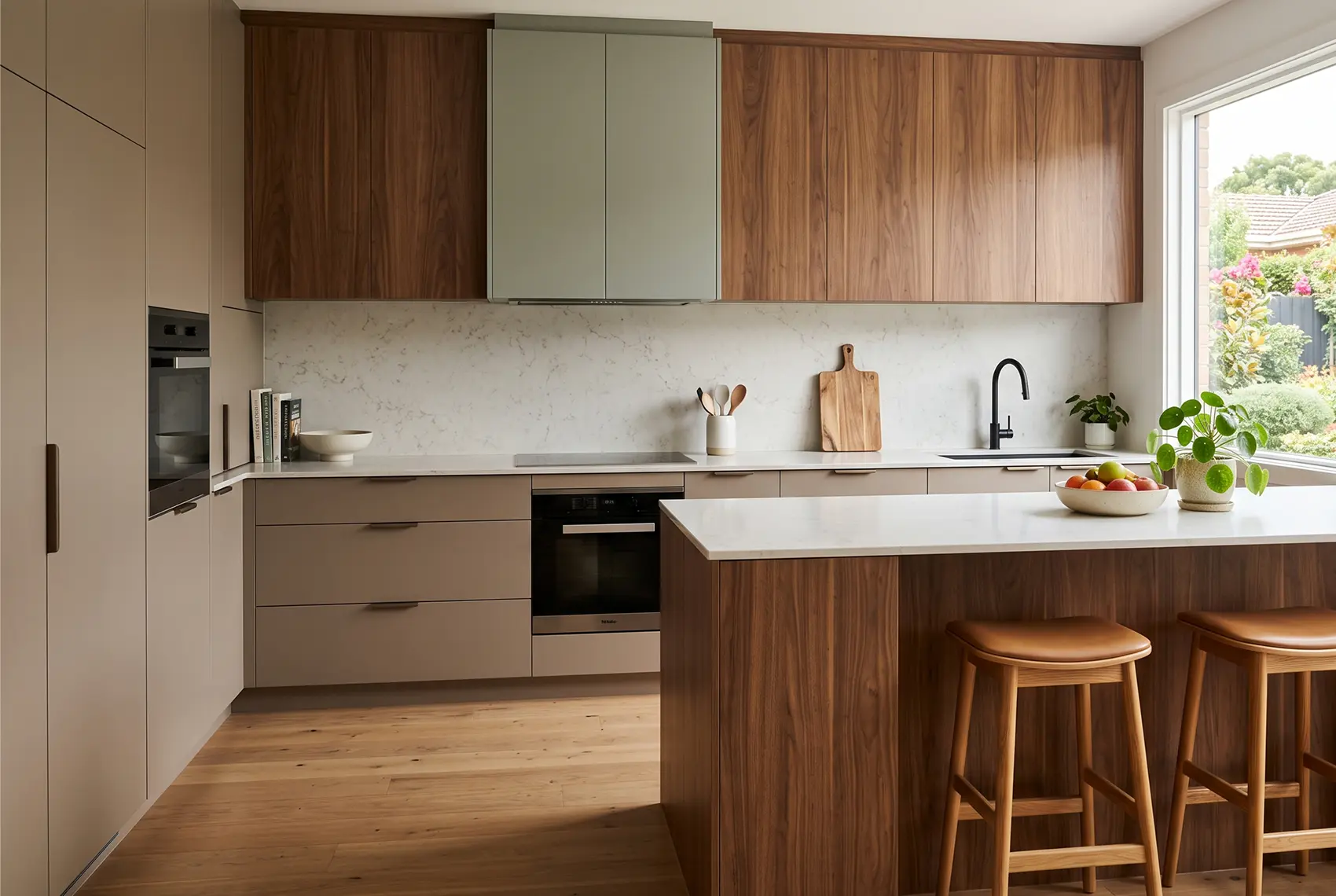
The best result often comes from combining materials. For example, a kitchen may use a practical decorative board for the internal cabinets, two-pack doors for feature areas and timber veneer for an island or overhead cabinet section.
The selected product grade, edge treatment, hardware, manufacturing and installation quality will influence performance just as much as the material name.
Cabinet Material and Cabinet Finish Are Not the Same
Before comparing options, it helps to separate two terms that are often used interchangeably.
The cabinet material, or substrate, is the board used to manufacture the cabinet component. Common substrates include MDF, particleboard and plywood.
The finish is the visible surface applied to that material. Examples include laminate, melamine, two-pack paint and timber veneer.
A kitchen door may therefore be made from MDF and finished in two-pack polyurethane. A cabinet carcass may use particleboard with a melamine decorative surface. A feature panel may use MDF or another suitable substrate covered with natural timber veneer.
This article focuses on complete finish decisions for homeowners. It does not repeat the technical manufacturing comparison between MDF, plywood and melamine-faced boards.
Kitchen Cabinet Finish Comparison Matrix
| Finish | General appearance | Everyday durability | Maintenance | Moisture considerations | Repairability | Relative price |
|---|---|---|---|---|---|---|
| Laminate or melamine-faced board | Solid colours, timber looks and textured designs | Good for normal household use when correctly specified | Generally easy to clean | Edges, joins and damaged areas need protection | Localised repairs can remain visible | Low to mid |
| Two-pack painted finish | Custom colours with matte, satin or gloss options | Good, but edges can chip if heavily impacted | Smooth and easy to wipe, although some sheens show marks | Coating and edge coverage are important | Can often be professionally repaired or refinished | Mid to high |
| Timber veneer | Natural grain with individual variation | Depends on veneer, coating and use | Requires suitable cleaning and care | Surface coating and protected edges are essential | Selected damage may be repairable by a specialist | High |
| Solid timber | Natural appearance with visible grain and character | Can perform well when correctly constructed and finished | May require more careful maintenance | Movement and finish selection must be considered | Can sometimes be sanded or refinished | High |
| Decorative feature surfaces | Product-specific colours, textures or metallic effects | Varies significantly by product | Follow the manufacturer’s instructions | Depends on the surface and substrate | Product-specific | Mid to premium |
This is a general comparison only. Performance and price vary between brands, product ranges, substrates, edge treatments and cabinet designs. Review physical samples and the manufacturer’s current specifications before approving a material.
Laminate Kitchen Cabinets
The term laminate kitchen cabinets can cover several types of decorative surfaces. In everyday kitchen discussions, it commonly refers to a durable decorative sheet or pre-finished panel applied to a board substrate.
Laminate and melamine-faced products are available in:
- Solid colours
- Timber-look patterns
- Stone-inspired designs
- Matte finishes
- Textured surfaces
- Fingerprint-resistant product ranges
- Subtle gloss finishes
Their main advantage is practicality. The surface arrives finished, which can support consistent manufacturing and reduce the additional painting work required after the panel is cut.
Laminate is commonly used for cabinet doors, end panels, overhead cabinets and kitchen islands. Melamine-faced board is also widely used inside cabinet carcasses because it provides a clean, finished surface that is generally easy to maintain.
Advantages of laminate cabinetry
- Broad selection of colours and textures
- Practical for busy household kitchens
- Generally easy to wipe clean
- Consistent appearance across multiple panels
- Available at different price and performance levels
- Timber-look options without the natural variation of veneer
- Suitable for modern and minimalist kitchens
Points to consider
- The quality and visibility of edge banding matter
- Damaged laminate can be difficult to repair invisibly
- Dark colours may show dust, fingerprints or scratches more easily
- Pattern repetition may be visible on large timber-look areas
- Product ranges can change, affecting future colour matching
- Heat and moisture exposure must still be managed carefully
Laminate is a strong option for families, rental properties and homeowners who prioritise straightforward maintenance. However, it should not automatically be treated as a basic or budget-only finish. Premium textured laminates can create a refined appearance when the door proportions, grain direction and edge details are planned properly.
Two-Pack Kitchen Cabinets Melbourne Homeowners Consider
Two-pack is a painted coating system commonly applied to prepared MDF cabinet doors and panels. It is popular because it offers significant freedom over colour, sheen and door style.
Homeowners considering two-pack kitchen cabinets Melbourne projects can select from smooth flat doors, routed profiles, Shaker-style doors and other decorative designs, subject to manufacturing suitability.
Two-pack can be finished in matte, satin, semi-gloss or gloss, depending on the available system and the required appearance.
Advantages of two-pack cabinetry
- Large choice of colours
- Can be matched to a selected colour reference
- Suitable for routed and profiled doors
- Creates a continuous painted appearance
- Available in several sheen levels
- Selected damage may be professionally repaired or refinished
- Works in contemporary, transitional and traditional kitchens
Points to consider
- Usually costs more than standard decorative board finishes
- Painted edges can chip following a strong impact
- Dark or high-gloss colours may show fingerprints and surface marks
- Colour matching during future repairs may be affected by ageing and light exposure
- Manufacturing and finishing quality have a significant effect on the result
- Cleaning products must be suitable for the coating
Two-pack may be the better option when a homeowner wants a specific colour or decorative door profile that is not available in a laminate range.
It is not automatically more durable in every situation. A high-quality laminate may be more practical for a heavily used family kitchen, while two-pack may provide greater design flexibility and repair options.
Timber Veneer Kitchen Cabinets
Timber veneer is made from thin layers of natural timber applied to a stable substrate. It delivers genuine timber grain without requiring every cabinet component to be manufactured from solid wood.
Each sheet can contain natural variations in grain, tone and pattern. These variations are part of the material’s character rather than defects.
Timber veneer kitchen cabinets can be used for:
- Kitchen islands
- Overhead cabinets
- Tall cabinet banks
- Feature doors
- Open shelving
- Integrated dining areas
- Decorative wall panels
Advantages of timber veneer
- Genuine natural timber appearance
- Adds warmth to white, grey and neutral kitchens
- Can be used as a feature without covering the entire kitchen
- Available in different species, cuts and stains
- Grain direction can strengthen the kitchen’s visual proportions
- Coordinates well with stone, concrete and painted finishes
Points to consider
- Natural colour and grain variation must be expected
- Direct sunlight may affect the appearance over time
- Grain matching requires careful planning
- The protective coating influences maintenance and moisture performance
- Repairs and replacement panels may not match perfectly
- Veneer generally sits in a higher relative price category
Veneer works best when its natural variation is intentionally included in the design. Homeowners seeking completely uniform doors may prefer a timber-look laminate instead.
Matte vs Gloss Kitchen Cabinets
The matte vs gloss kitchen cabinets decision is primarily about sheen rather than the underlying material. Laminate and two-pack products may both be available in different sheen levels.
Matte finishes
Matte surfaces absorb more light and produce a softer, understated appearance. They work well in contemporary kitchens and can complement natural timber, stone and textured materials.
Some matte products reduce the visibility of fingerprints, but this depends on the particular colour and surface technology. Very dark matte cabinetry can still show oils, dust or cleaning streaks.
Gloss finishes
Gloss surfaces reflect light and may help a compact or darker kitchen feel brighter. They can create a polished, highly contemporary appearance.
However, reflective surfaces are more likely to display fingerprints, smudges and imperfections. They may require more frequent wiping, particularly around handles, integrated pulls and frequently used doors.
Satin or semi-gloss finishes
A mid-sheen finish provides a balance between the softness of matte and the reflective quality of gloss. It can be practical for homeowners who want painted cabinetry without a completely flat or highly polished appearance.
The best sheen should be assessed using a full-size sample in the actual kitchen lighting. A small sample viewed in a showroom may look different when installed across an entire wall of cabinets.
Which Kitchen Cabinet Finish Is Easiest to Maintain?
Quality laminate or melamine-faced cabinetry is generally among the easiest options to maintain because it has a ready-finished, non-porous decorative surface.
For normal cleaning:
- Remove spills promptly
- Use a soft cloth
- Follow the product manufacturer’s cleaning instructions
- Avoid abrasive pads
- Avoid harsh or unapproved chemicals
- Dry water collecting around joins and edges
- Use handles carefully rather than pulling from door corners
Ease of maintenance also depends on colour and sheen. Mid-tone colours, subtle textures and satin finishes may conceal everyday marks better than very dark matte surfaces or high-gloss doors.
Handleless cabinetry can look clean and minimal, but frequently touched rails and door edges may require more regular wiping.
What Cabinet Material Is Best Around Moisture?
No timber-based kitchen cabinet should be treated as waterproof.
Areas around sinks, dishwashers, kettles and plumbing require careful detailing because repeated water exposure, steam or a leak can affect boards, edges and coatings.
Moisture performance depends on:
The selected substrate and product grade
Edge sealing or edge banding
Quality of joins and cut-outs
Sink and benchtop installation
Plumbing connections
Dishwasher clearances
Ventilation
Prompt cleaning of spills
Protection of exposed edges and penetrations
Moisture-resistant board products may provide additional protection in appropriate applications, but moisture-resistant does not mean waterproof.
The best approach is to select a suitable product system and reduce the opportunity for water to reach the board core. This is especially important around sink cabinets and dishwasher openings.
How Melbourne Homes Influence Finish Selection
Melbourne does not have one universal kitchen style or housing type. The finish should respond to the particular property.
Apartments and compact units
Light or balanced colours, consistent door lines and integrated appliances can reduce visual clutter. Durable laminate or a carefully selected two-pack finish may work well, depending on the desired appearance and budget.
Family homes
Easy cleaning and impact resistance often become priorities. Textured laminate, practical colours and quality hardware can support daily use by children and busy households.
Period homes
Two-pack routed doors may complement traditional architectural details. Timber veneer or solid timber features can introduce warmth without making the kitchen feel overly decorative.
Contemporary townhouses
A combination of matte cabinetry, timber-look finishes and feature veneer can provide contrast while maintaining clean lines.
Homes with strong natural light
Dark colours and timber finishes can work successfully, but samples should be checked at different times of day. Strong sunlight may reveal fingerprints, change how colours are perceived and affect some natural materials over time.
A Practical Decision Guide
Use the following priorities to narrow your options.
Choose laminate when:
- Easy maintenance is a leading priority
- You want predictable colours or timber patterns
- The kitchen will receive frequent family use
- You prefer a practical low-to-mid relative price range
- Routed door profiles are not essential
Choose two-pack when:
- You want a specific paint colour
- Your design includes Shaker or routed doors
- You prefer a seamless painted appearance
- Professional repair or future refinishing is important
- The higher relative cost suits the project budget
Choose timber veneer when:
- Natural grain is central to the design
- You are comfortable with variation
- You want to introduce warmth through selected feature areas
- Grain matching can be considered during manufacturing
- The premium relative price suits the project
Combine finishes when:
- One finish across the entire kitchen feels visually heavy
- High-use areas need a more practical surface
- The island should act as a feature
- You want natural warmth without using timber everywhere
- Different areas have different maintenance requirements
Questions to Ask Before Approving Your Cabinet Finish
Before making a final decision, ask your cabinet maker or supplier:
What substrate is used beneath the visible finish?
Is the product suitable for kitchen doors, panels and high-use areas?
How are the edges finished?
What cleaning products are recommended?
How does the sample look in natural and artificial light?
Will fingerprints or cleaning streaks be visible?
Can damaged doors or panels be repaired or replaced?
How will timber grain or decorative patterns align?
Is the selected colour part of a standard or limited range?
Which areas need additional moisture protection?
Does the quote specify the exact product and finish?
Can different finishes be combined within the same kitchen?
These questions provide a stronger basis for comparison than choosing from colour samples alone.
Kitchen Cabinet Materials and Finishes with Sagar Cabinets
Sagar Cabinets designs and manufactures custom kitchen joinery for Melbourne homes. Material and finish selection can be considered alongside the kitchen layout, storage requirements, appliances and the way the household uses the room.
Rather than selecting a finish based only on appearance, homeowners can compare physical samples and discuss practical factors such as cleaning, moisture exposure, sunlight, edge details and expected household use.
Whether you are considering low-maintenance laminate, custom-coloured two-pack cabinetry or natural timber veneer, the goal is to create a kitchen that feels cohesive and performs well in everyday life.
Contact Sagar Cabinets to discuss your kitchen cabinetry project and explore suitable material and finish options.
Frequently Asked Questions
What is the best material for kitchen cabinets in Australia?
- There is no single best option. Quality laminate suits homeowners seeking practicality and straightforward maintenance. Two-pack provides greater colour and door-profile flexibility, while timber veneer offers a natural appearance. The best material depends on the kitchen design, household use, moisture exposure and budget.
Which kitchen cabinet finish is easiest to maintain?
- Laminate and melamine-faced surfaces are generally easy to maintain with suitable cleaning products and a soft cloth. Mid-tone colours and subtle textures may conceal everyday marks better than very dark matte or high-gloss finishes.
Is laminate or two-pack better for kitchen cabinets?
- Laminate may be better for a busy household prioritising durability, easy cleaning and cost control. Two-pack may be better when a custom colour, routed profile or painted appearance is required. Neither is universally superior.
What cabinet material is best around moisture?
- The complete material system matters more than the finish name alone. Appropriate substrates, protected edges, sealed penetrations and correct installation are essential. Moisture-resistant products can help in suitable applications, but they should not be considered waterproof.
How long do different kitchen cabinet finishes last?
- There is no reliable universal lifespan for a finish. Performance depends on product quality, household use, exposure to water and sunlight, cleaning methods, manufacturing, installation and maintenance. Review the product specifications and warranty rather than relying on a general lifespan claim.