
Cabinetry is often described as standard, modular, semi-custom, custom or bespoke. These labels can sound interchangeable, but they represent different levels of design flexibility, manufacturing and personalisation.
Standard cabinetry offers a practical solution based on predetermined sizes and finishes. Bespoke joinery begins with the individual room, its dimensions and the way the client intends to use it. Between these options are modular and semi-custom products that provide some flexibility without being completely project-specific.
None of these approaches is automatically right for every home. A standard cabinet may be perfectly suitable for a straightforward laundry or temporary renovation. Bespoke cabinetry may be more appropriate for a premium kitchen, unusual wardrobe, architectural living area or room where every millimetre matters.
This guide explains each cabinetry category, compares their differences and provides a practical checklist to help Melbourne homeowners choose confidently.
Cabinetry Categories Explained
Before comparing products or quotations, it helps to understand the four common cabinetry categories.
1. Standard cabinetry
Standard cabinetry is produced in established dimensions, configurations and finishes. Customers select from the available range rather than changing the fundamental design.
This category may include freestanding cabinets, ready-made bathroom vanities and pre-assembled storage units. Standard cabinetry can be practical when the room suits the available dimensions and individualisation is not a priority.
2. Modular cabinetry
Modular cabinetry uses standard-sized units that can be arranged in different combinations. A kitchen may include separate drawer units, cupboards, pantry cabinets and overhead modules selected from an established system.
Modular ranges provide more layout flexibility than a single standard cabinet, but each unit still has fixed dimensions. Filler panels may be required where the modules do not exactly match the room.
3. Semi-custom cabinetry
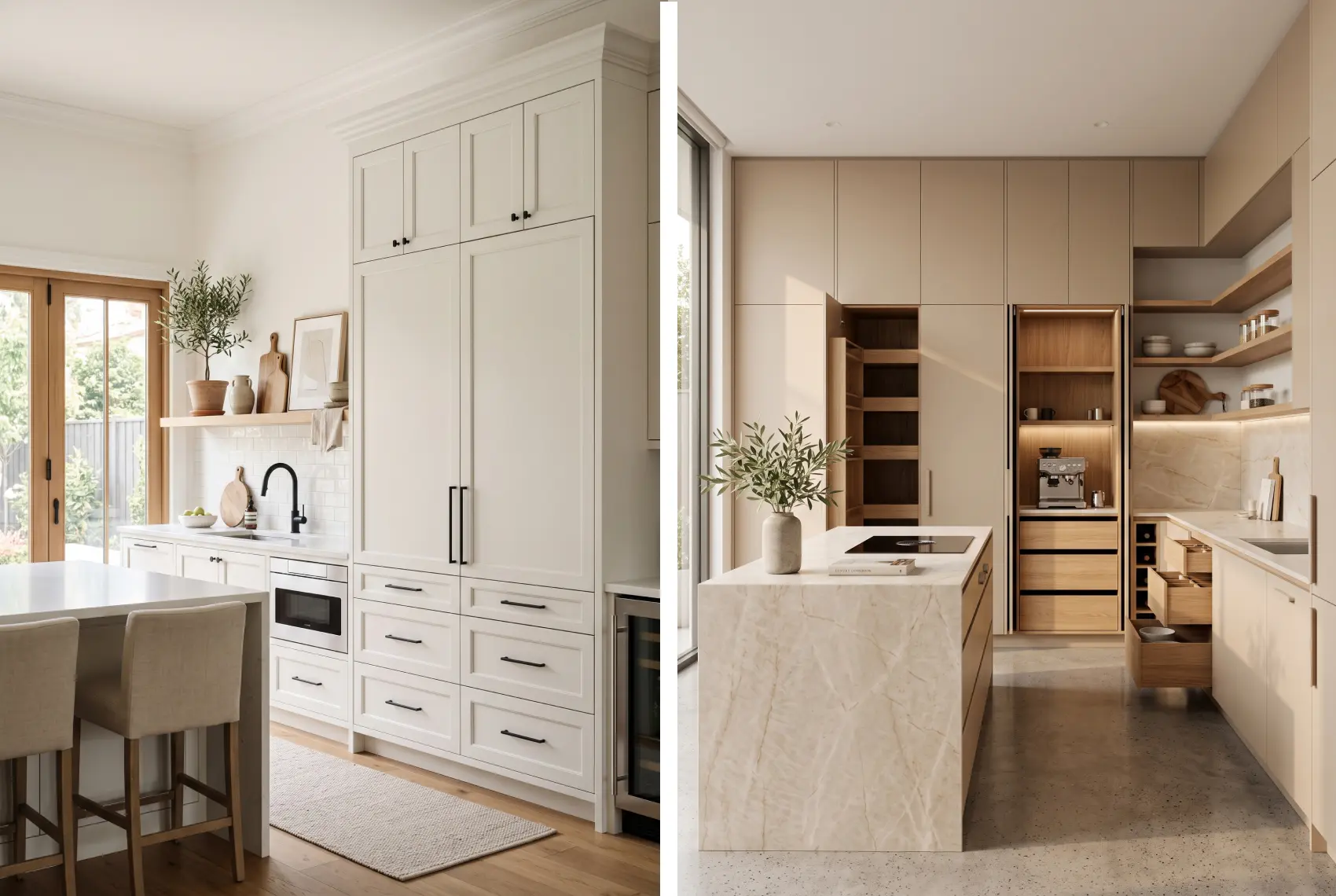
Semi-custom cabinetry begins with a standard product system but allows selected changes. Depending on the supplier, customers may be able to choose different door profiles, colours, handles, hardware or limited cabinet-size adjustments.
This can provide a useful balance between convenience and personalisation. However, changes remain restricted by the manufacturer’s product range and production system.
4. Bespoke cabinetry
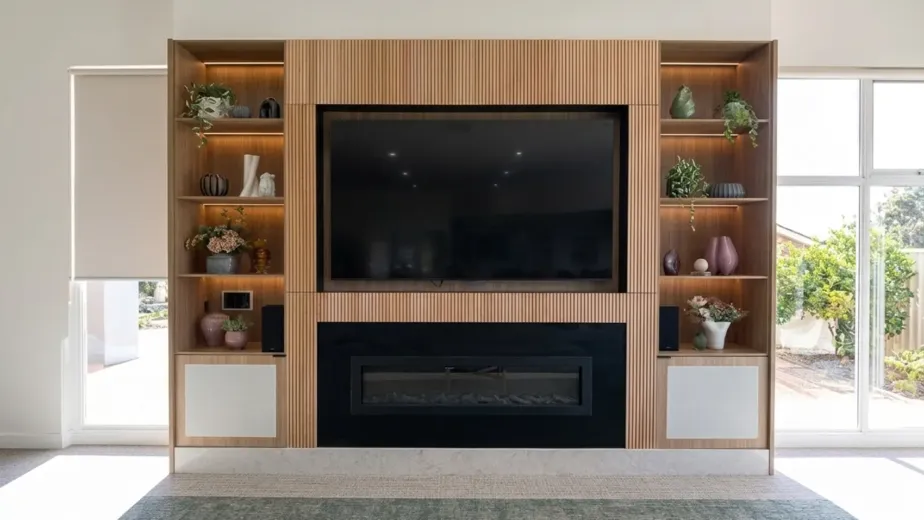
Bespoke cabinetry is designed and manufactured specifically for the client, room and intended use. The process begins with the project requirements rather than an existing product catalogue.
Dimensions, internal storage, materials, hardware, colours and finishes can be developed for the individual project. The finished joinery may be designed to stand out as a feature or integrate quietly into the architecture.
Bespoke Joinery vs Standard Cabinetry: The Essential Difference
Standard cabinetry asks, “Which available product fits this room?”
Bespoke joinery asks, “What should be created for this room?”
That difference influences every later decision, including measurements, storage, materials, detailing, manufacturing and installation.
- Bespoke joinery vs standard cabinetry: Bespoke joinery is designed for a particular space, while standard cabinetry is selected from predetermined products.
- Bespoke cabinetry Melbourne: Suitable for individual layouts, unusual dimensions and clients seeking greater control over the result.
- Bespoke joinery Melbourne: Can address kitchens, wardrobes, vanities, living rooms, home offices and architectural features.
- Custom joinery solutions Australia: May respond to different property types, interior styles and project requirements across residential applications.
Comparison at a Glance
| Factor | Bespoke Joinery | Semi-Custom Cabinetry | Standard Cabinetry |
|---|---|---|---|
| Dimensions | Designed for the room | Limited size modifications | Fixed sizes |
| Internal Layout | Fully project-specific | Selected configurations | Predetermined |
| Materials | Broad selection | Supplier range | Limited range |
| Colours and Finishes | Highly flexible | Selected options | Fixed options |
| Hardware | Specified for the project | Range-based selection | Standard inclusion |
| Architectural Integration | High | Moderate | Limited |
| Site Measurement | Usually required | May be required | Buyer responsibility may apply |
| Manufacturing | Made for the project | Modified production system | Mass-produced |
| Installation | Often professionally coordinated | Varies by supplier | DIY or separately arranged |
| Lead Time | Generally longer | Moderate | Often shorter |
| Initial Price | Generally higher | Mid-range | Generally lower |
Difference 1: Fit and Use of Space
Standard cabinets are designed to work in many properties. This makes them convenient, but their fixed dimensions may leave gaps or require filler panels.
Made-to-measure cabinets are designed from site dimensions. Width, height and depth can be adjusted to suit the room, subject to safe construction, material limitations and hardware requirements.
This flexibility is valuable in Melbourne properties with:
- Uneven walls
- Sloping floors
- High ceilings
- Narrow rooms
- Chimney breasts
- Decorative cornices
- Existing fireplaces
- Structural columns
- Angled walls
- Restricted apartment layouts
Made-to-measure does not mean cabinetry can ignore building tolerances. Installers still require suitable clearances, scribes and fillers to account for site variations and allow doors to operate correctly. The difference is that these details can be planned as part of the design.
Difference 2: Storage Designed Around the User
A standard wardrobe might provide a shelf and hanging rail. A standard vanity might contain two doors and one internal shelf. These arrangements suit many people, but they do not consider what a particular household needs to store.
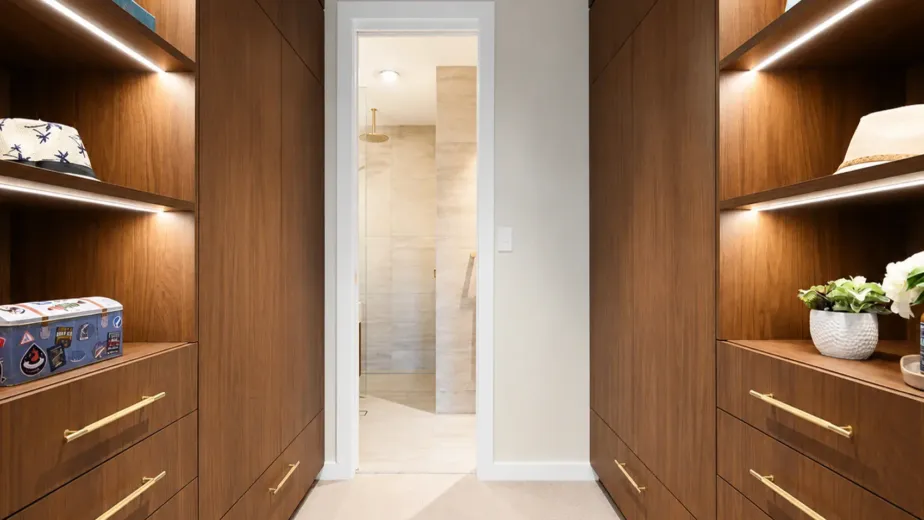
Tailored storage cabinetry can divide the interior according to the user’s possessions and routines.
- Separate long and short hanging sections
- Shoe shelves
- Internal drawers
- Accessory trays
- Luggage cupboards
- A concealed dressing table
A living-room unit could combine:
- Media equipment
- Ventilated cabinets
- Display shelves
- Book storage
- Cable access
- Children’s storage
This level of planning is useful where the room must perform several functions or where available space is limited.
Difference 3: Materials and Finishes
Standard cabinetry generally provides a limited, carefully selected range. This simplifies the purchase process and allows manufacturers to produce products efficiently.
Bespoke cabinetry can provide a broader material palette, which may include:
- Melamine
- Laminate
- Moisture-resistant
- MDF
- Painted doors
- Timber veneer
- Solid timber features
- Textured panels
- Decorative glass
- Custom colours
- Specialist hardware
Bathroom cabinetry may need finishes suitable for a moisture-prone environment. A home office may require durable work surfaces and cable management. A living-room feature may prioritise grain matching and visual detail.
A unique joinery design in Melbourne should balance appearance with durability, cleaning, maintenance and the conditions of the room.
Difference 4: Design Freedom
Bespoke joinery can be adapted to the architectural language of a property.
For a period home, cabinetry might use balanced proportions, framed doors and finishes that respect existing details. In a contemporary property, it may use full-height panels, concealed handles and minimal junctions.
Design possibilities can include:
- Floor-to-ceiling cabinetry
- Wall-to-wall installations
- Curved forms
- Integrated desks
- Concealed doors
- Window seats
- Custom libraries
- Detailed display units
- Coordinated cabinetry across several rooms
- Integration with lighting and technology
Handcrafted joinery pieces can also be created as individual features, such as a freestanding cabinet, home bar, vanity or display unit. The level of hand finishing will vary according to the material, construction method and design.
Design freedom still requires technical discipline. A concept must be buildable, durable and suitable for the selected hardware and materials.
Difference 5: Manufacturing and Craftsmanship
Standard cabinetry is usually manufactured in volume using repeatable dimensions and processes. This supports efficient production and consistent product output.
Bespoke joinery also uses precision machinery, but the components are produced for an approved project. CNC machining may be combined with manual assembly, detailed finishing and site-specific installation.
- Reviewing the design brief
- Completing a site measure
- Developing technical drawings
- Confirming materials and hardware
- Preparing samples
- Manufacturing project-specific components
- Assembling and checking cabinetry
- Delivering and installing on-site
- Adjusting finished panels to surrounding surfaces
Craftsmanship is not limited to traditional hand tools. In contemporary cabinetry, it includes accurate planning, appropriate material selection, precise machining, controlled assembly and careful installation.
Difference 6: Time and Project Involvement
Standard cabinetry can often be selected and purchased relatively quickly. If products are in stock and the room is ready, the project may move to assembly and installation without an extended design phase.
Bespoke joinery requires greater client involvement before manufacturing. Decisions need to be made about:
- Layout
- Storage
- Materials
- Colours
- Hardware
- Appliances
- Lighting
- Electrical access
- Installation timing
This process generally takes longer, but it can resolve potential problems before production begins. Clients should allow enough time for measurement, design, approvals, material procurement, manufacturing and installation.
A rushed decision can be expensive in either category. Standard products may be ordered in the wrong size, while bespoke projects can be delayed by late changes or unconfirmed selections.
Difference 7: Cost and Long-Term Value
Standard cabinetry generally has the lowest initial purchase price because the design, materials and production process are repeated across many units.
Bespoke joinery typically costs more because the project includes individual planning, measurement, manufacturing and installation. Premium materials, specialist finishes and complex hardware may increase the investment further.
However, value should not be assessed by initial price alone. Consider:
- How efficiently the cabinetry uses the room
- Whether it meets the required function
- The specification of materials and hardware
- The quality of installation
- How long you plan to use it
- Whether it supports the architecture
- The cost of future compromises or modifications
A standard cabinet that fits well and meets the brief can offer excellent value. Bespoke cabinetry may provide stronger value when a standard product would waste space, disrupt the design or fail to provide the required storage.
Myth or Reality?
Myth: Bespoke cabinetry is only for very large homes
Reality: Bespoke joinery can be especially useful in small apartments, narrow rooms and unusual spaces because it can make more efficient use of the available area.
Myth: Standard cabinets always look inexpensive
Reality: Well-selected and professionally installed standard cabinetry can produce a clean result. The outcome depends on product quality, planning, fit and installation.
Myth: Bespoke means every component is made by hand
Reality: Modern bespoke joinery often combines digital drawings, CNC machining, skilled assembly and detailed installation. Technology supports precision while craftsmanship guides the complete process.
Myth: Bespoke cabinetry never needs fillers
Reality: Fillers and scribes may still be required for door clearance and to accommodate uneven site surfaces. Bespoke design allows these details to be planned more carefully.
Myth: A higher price automatically means higher quality
Reality: Quality depends on the complete specification, including materials, hardware, construction, finishing and installation. Always review what is actually included.
Selection Checklist: Which Type Should You Choose?
Use the following checklist before deciding.
Standard cabinetry may be suitable when:
- The room has straightforward dimensions.
- An available product fits without major modifications.
- Your storage requirements are simple.
- You are satisfied with the existing finish selection.
- You need a faster purchasing process.
- The cabinetry is for a short-term or basic upgrade.
- Keeping the initial cost low is the main priority.
Semi-custom cabinetry may be suitable when:
- Standard dimensions mostly suit the space.
- You want some control over doors, colours or hardware.
- You do not require a completely individual internal layout.
- Moderate design flexibility is enough.
- You want a balance between convenience and choice.
Bespoke cabinetry may be suitable when:
- The room has irregular dimensions.
- You want to use the full practical height or width.
- Storage must be planned around specific possessions.
- Appliances or technology require integration.
- The cabinetry must align with architectural details.
- You require a particular material or finish.
- Several rooms need a coordinated design.
- A precise, made-to-measure result is important.
Questions to Ask Before Accepting a Quote
Ask:
- Is site measurement included?
- Are design or shop drawings provided?
- What are the carcasses, doors and panels made from?
- Which hinges and drawer runners are specified?
- Are delivery and installation included?
- Are fillers, scribes and finished end panels included?
- Which items are excluded?
- Who is responsible for coordinating other trades?
- What is the estimated lead time?
- How are variations handled after approval?
Bespoke Joinery Melbourne by Sagar Cabinets
With more than 40 years of craftsmanship experience, the team works with homeowners, builders, architects and interior designers to develop cabinetry around each project’s dimensions, function and visual direction.
The process considers how the cabinetry will be used, how it relates to the room and which materials and details are appropriate. Precision manufacturing is then combined with careful installation to produce a coherent result.
Frequently Asked Questions
What is the difference between bespoke and standard cabinetry?
- Bespoke cabinetry is designed and manufactured for a specific client, space and purpose. Standard cabinetry is produced in predetermined sizes, layouts and finishes. Bespoke joinery provides greater control over dimensions, storage, materials and detailing, while standard cabinetry usually offers a faster and more economical purchasing process.
Is bespoke joinery worth the investment?
- Bespoke joinery may be worth the investment when it improves the use of space, solves an unusual layout, provides specialised storage or achieves a particular architectural result. Its value depends on the project, material specification, workmanship, installation and how long the cabinetry will be used.
How long does bespoke cabinetry last?
- There is no single guaranteed lifespan. Longevity depends on materials, hardware, construction, installation, environment, maintenance and daily use. Well-designed and properly maintained cabinetry made with suitable materials can provide many years of service.
What does a bespoke joiner do?
- A bespoke joiner interprets the client’s requirements, assesses the space, develops buildable cabinetry details and manufactures components for the individual project. The service may also include material selection, technical drawings, hardware specification, delivery and installation.
When should I choose made-to-measure cabinetry?
- Choose made-to-measure cabinetry when standard products do not fit efficiently, the room has unusual dimensions, storage must be personalised or the cabinetry needs to integrate with appliances and architectural details. It is also suitable when you want greater control over materials, finishes and proportions.
Choose According to the Project, Not the Label
Standard, semi-custom and bespoke cabinetry each have an appropriate place. The best decision comes from understanding the room, required function, expected finish, available timeframe and overall budget.
Focus on the actual specification rather than marketing terminology. A detailed comparison of dimensions, materials, hardware, design involvement and installation will show which option offers the most suitable value for your home.
For project-specific cabinetry designed around your Melbourne property, speak with Sagar Cabinets about a bespoke joinery consultation.